
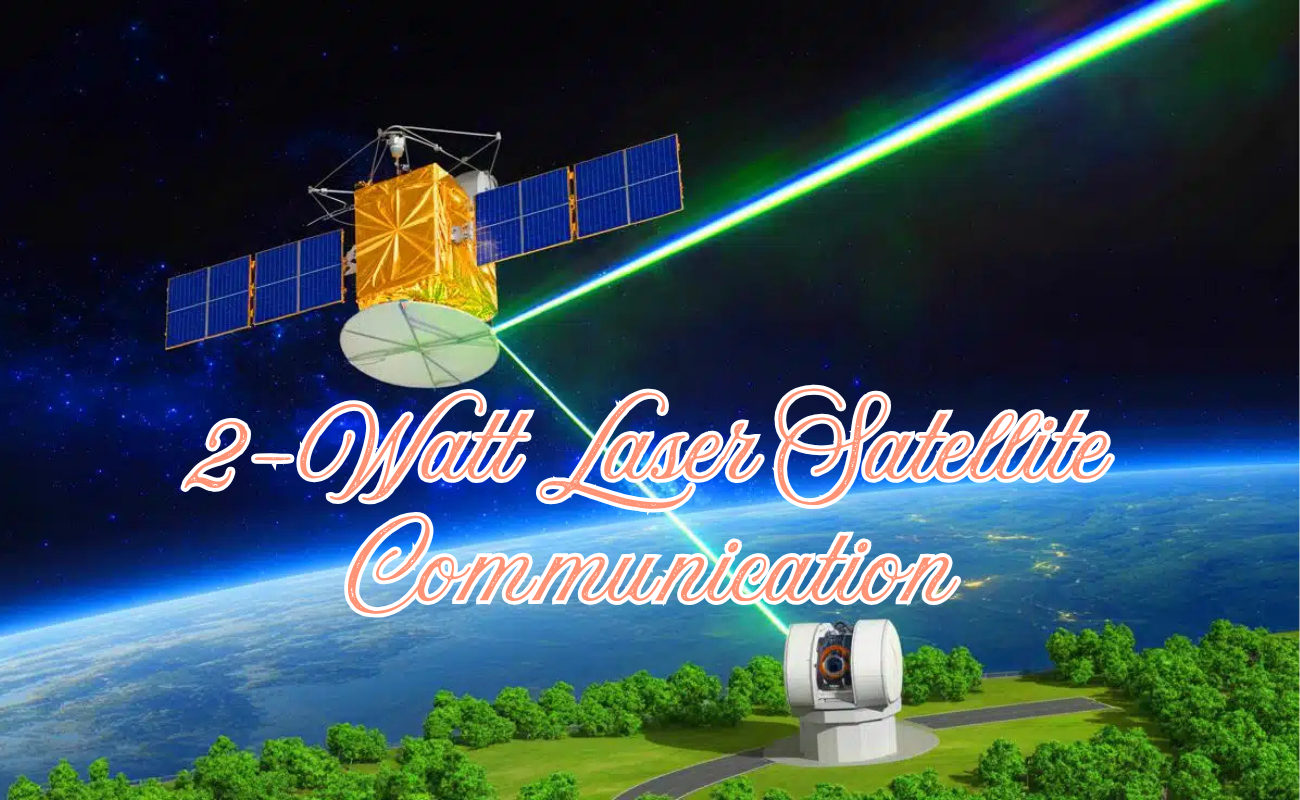
A satellite has easily beaten traditional systems in terms of power consumption. In 2025, the Chinese researchers sent data from geostationary orbit via 2-watt laser satellite communication (LSC), which is the power of a household LED bulb, and achieved a speed of 1 gigabit per second on the ground.
This article explains how the technology works, why the 2 watts is significant and what it means for the future of space internet. This will be straightforward, no engineering knowledge required.
What is 2-Watt Laser Satellite Communication?
In other words, it is a method of transmitting data from a satellite to the earth (or from one satellite to another) by transmitting a laser beam with only 2 watts of electricity. This equates to the power consumption of a small LED light in your living room. With such little energy, the beam can transmit a powerful data signal over distances of tens of thousands of kilometers in space.
Why 2 Watts Is a Big Deal
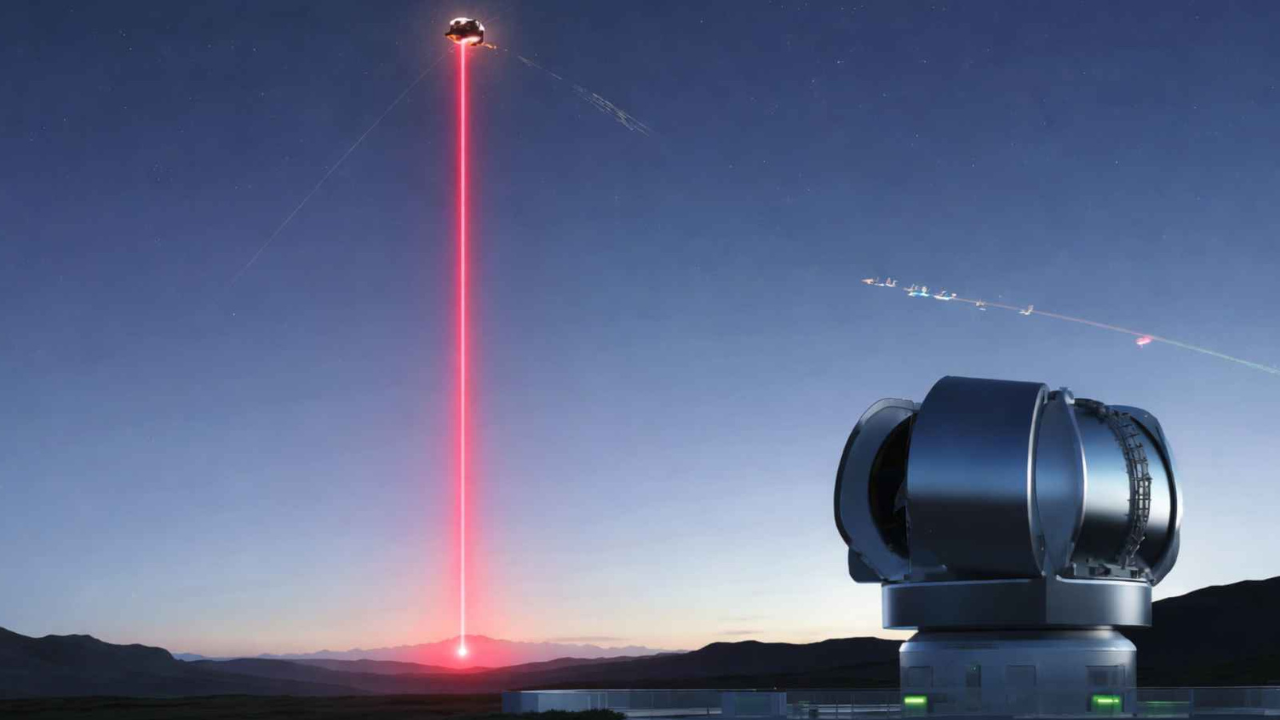
Radio transmitters require tens or even hundreds of watts to push a signal down to Earth, most satellites employ such transmitters. A 2-watt laser link will do the same with a fraction of that power. There is a finite amount of energy on a satellite and any watt that can be saved in communications can be put toward cameras, sensors, or other equipment.
How Optical Satellite Communication Works
It is part of a larger group of communications known as optical satellite communication, which utilizes light to transmit data rather than radio waves. If you want to make the point to someone in a room, you can shout or use a narrow beam of light from a flashlight, but the flashlight requires a lot of precision in the aiming.
The transmitter: The light signal is generated by a tiny laser diode in the satellite, which is typically amplified by an optical amplifier that amplifies the signal without consuming much additional power.
The receiver: A telescope on the ground receives the beam of light. A larger, more accurately designed telescope will be able to detect a feeble signal from a great distance.
The atmosphere problem: Light is bent and scattered due to changes in air density and temperature as it passes through the atmosphere, just as the stars twinkle. Engineers are able to correct the beam in real time by using small mirrors called adaptive optics.
Read Also: What Is Section 45 of the Income Tax Act
Real-World Example: China’s Geostationary Laser Test
The most obvious example of this technology is offered by a demonstration in 2025 by a group of researchers affiliated with Peking University and the Chinese Academy of Sciences. They transmitted a laser beam from a geostationary satellite (some 36,000 km above the ground) to a ground station in Yunnan province. The team achieved a data rate of approximately 1 gigabit per second with only 2 watts of power, which is a very high rate of data transfer, as geostationary orbit is about 60 times further away than the typical low-Earth-orbit satellites.
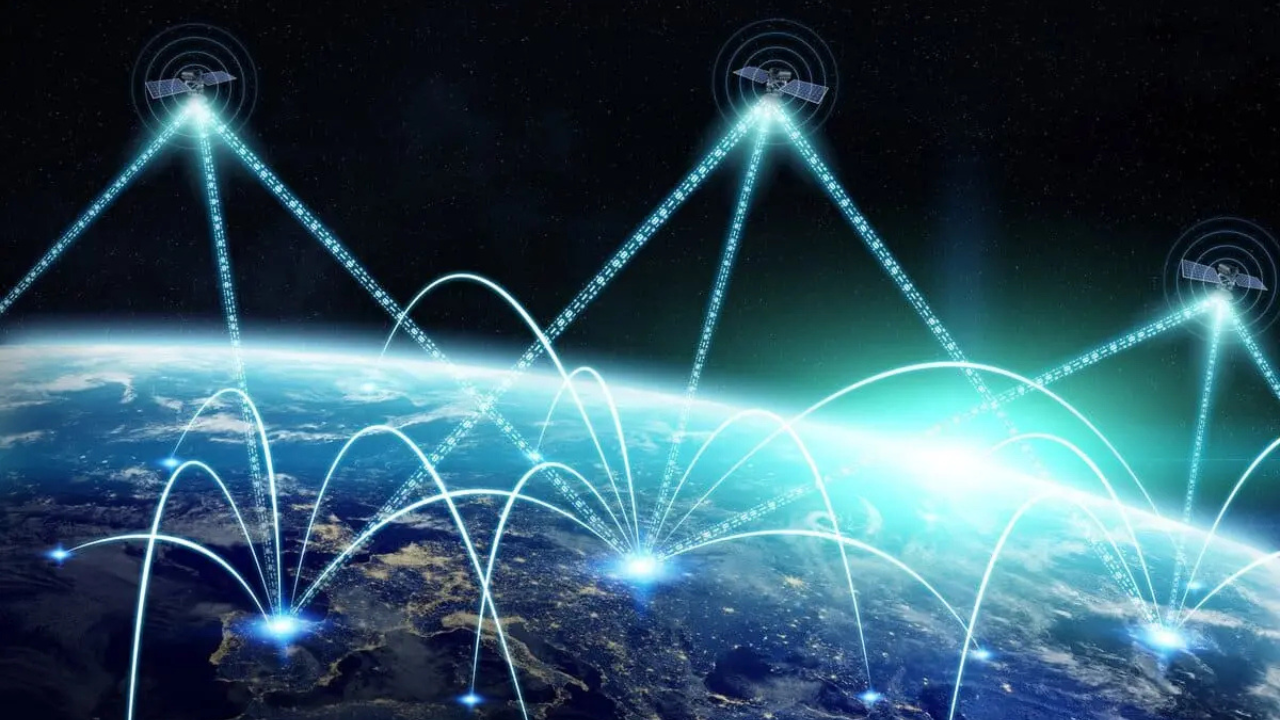
They did this in two ways: by applying adaptive optics to correct for the turbulent air after it traveled through, and by breaking the signal up into several channels and recombining the ones that were clearest. Keep in mind that this was a research test, and not a commercial product, so the numbers should be viewed as a snapshot of what is currently possible.
Traditional Radio Systems versus 2-Watt Laser
Speed: Laser links typically can transmit much more information than radio links of the same size and power because light is transmitted at a higher frequency.
Power efficiency: 2-watt laser satellite comms are even better, it can perform at the same level as radio, or better, with only a tiny fraction of the power usage.
Security: Narrow and focused laser beams cannot be picked up as easily as radio waves that radiate in all directions.
The catch: It’s extremely precise aiming that’s required. This can be lost at any time if there’s a slight wobble or some rough weather, hence the continued use of radio for most satellite communication today.
Significance of This Technology For Future
Low-power laser links provide the ability to transfer the information back to the earth’s surface without consuming excessive power in the satellite’s limited power system.The more cameras and sensors can be loaded onto a satellite, the more data must be sent home, and the less power that satellite can use to do so. One very efficient geostationary satellite could also provide coverage across a large area, cutting down on the need for a large satellite constellation.
Laser beams are also being used by governments and financial networks, which are looking for secure links, as they are narrow and hard to intercept. Also, 2-watt systems consume such a small amount of power that they may someday be able to be incorporated into small satellites, such as the shoebox-size CubeSats.
Final Word
Two watts is all that is needed for laser satellite communication and more power is not necessarily better. The combination of a low-power laser, smart optics and signal processing has enabled researchers to attain data transmission speeds that are competitive to and at times superior to, traditional radio systems while consuming less energy than a light bulb.
FAQs
1.What are the uses of 2 watt Laser satellite communication?
Carries data, pictures, video or Internet traffic from one satellite to a ground station or from one satellite to another, via a low-power laser.
2.Is satellite communication using a laser to 2 watts safe?
Yes, constructed and managed to prevent eye and ground damage. This is not a safety issue, it’s a beam stabilization issue.
3.How is optical satellite communication different from radio?
Unlike radio waves, optical links incorporate infrared light, enabling data rates to be higher and making interception more difficult.
4.How can a 2W laser beat more powerful radio systems?
Yes, if the conditions are favorable. A Chinese test achieved 1 Gbps from geostationary orbit using only 2 watts, matching some radio based tests.
5.Could this be used in the daily internet?
Not yet, the vast majority of the laser communications links in current use are research prototypes or narrowband government or inter-satellite communications links.
Read More: Encuentra el Ritmo: What This Phrase Actually Means and Why It Keeps Popping Up Everywhere