
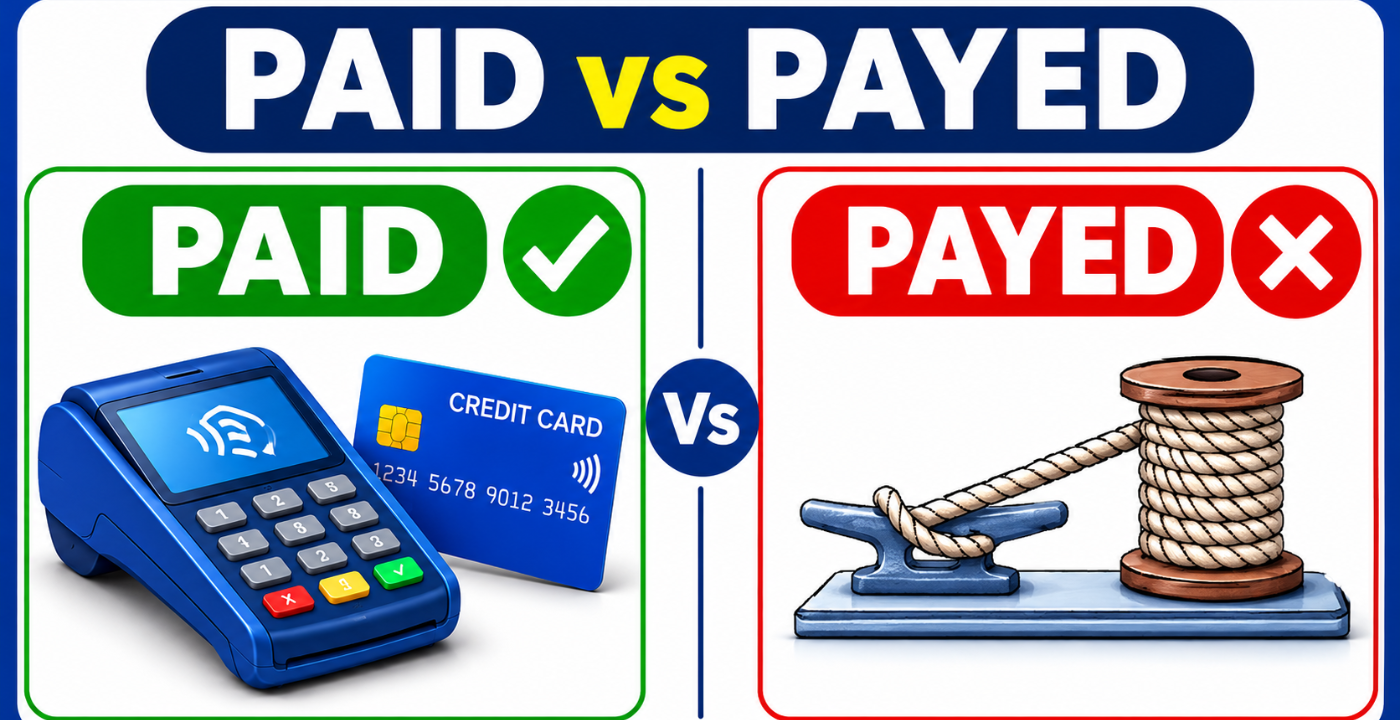
Many writers hesitate and pause when they need the past tense of “pay.” Does it pay or does it pay? Avoid a common mistake in emails, essays and reports by knowing the difference between payed and paid. The past tense for “paid” is the standard and is used for money and things done daily.
This uncommon spelling, only found in sailing, for sealing a ship’s seams or letting out a rope. This article will tell you what the difference is, provide definitions of each, and have a simple trick to help you remember which word to use.
What Does “Paid” Mean?
The past tense and past participle of the verb “pay” is “paid.” It’s the word you should use in nearly any circumstance, particularly if you’re getting involved with money.
Pay is an irregular verb, and it doesn’t follow regular rules to form the past tense by adding “-ed”. That’s why payed seems correct to many and is typically incorrect.
There are many common phrases that include the word “paid,” including “paid attention,” “paid a visit,” “paid off,” and “paid the price”. In all of these words, “paid” is the only right spelling.

Examples:
- The groceries were paid for by card.
- She has made her rent payments each month.
- He listened attentively in the lecture.
- After all their hard work, their efforts finally came to fruition.
When Is “Payed” Correct?
Only in a nautical (sailing) context is “payed” the correct word. It has two meanings:
- To bind seams on a boat with tar or pitch. This was done on sailors to prevent water from disturbing between wooden planks.
- To let out a rope or cable slowly. Typically, it is written as “payed out,” but “paid out” is also acceptable.
Examples:
- The crew payed the deck seams with hot tar before the voyage.
- As the boat drifted back, Maria paid out the anchor line.
Outside of ships and ropes, “payed” is a spelling mistake. This sailing sense is most often not relevant to most people and thus you will not often have occasion to write it.

Read Also: Glutathione Tablets: Uses, Side Effects, Dosage and Precautions
Payed vs Paid: The Key Difference
The distinction lies in things that are meant and things that are not and in context. Both words are derived from the verb “pay,” but are used in completely different contexts.
| Paid | Payed | |
| Meaning | Past tense of “pay” in almost every sense | Past tense of “pay” in two sailing senses |
| Used for | Money, favors, effort, idioms | Sealing ship seams, letting out rope |
| How common | Very common | Very rare |
| Example | She paid the bill. | He payed the hull with tar. |
A general policy aids here. Use paid instead of your sentence if it is not about boats, ships or ropes.
How to Remember the Difference
Payday, rather than sails! When you receive your wages, you say you were paid your wages. That means you’ll require this meaning almost all the time.
An alternative mnemonic is that “payed” is the word for sailors, while “paid” is the word for everyone else. If you are not on a boat, write “paid.”
Final Word
In just about all contexts, the past tense of pay is paid. The word “payed” is unusual and is only used to seal the seams of a ship or to let out a rope. If it’s not a sailing sentence, write “paid.” To avoid this common error, perform a quick grammar check before publishing.
FAQs
1.Is “payed” ever correct?
Of course, only at sea. Payed is to secure a ship’s seams with tar or to let out a rope slowly. Otherwise, use “paid”, such as when talking about money.
2.Is it ‘paid attention’ or ‘payed attention’?
It’s correct to say “paid attention. The past tense of “pay” in all its meanings, including other past-tense verbs derived from “pay,” such as “paid attention” and “paid a visit,”.
3.What is the past tense of the word ‘pay’?
Past tense and past participle of the verb “pay” is “paid.” It is not a regular verb, it does not end in “-ed.” For instance, you would say “She paid the bill yesterday” or “The bill was paid.”
4.It is “paid off” or “payed off?
Use “paid off.” It doesn’t matter whether you mean clearing a debt (“We paid off the loan”) or a plan that worked (“The effort paid off”).
5.How can I remember when to use “payed”?
Link “payed” to sailors and ships. In sentences about tarring a hull, or letting out a rope (or letting go of), “payed” might be appropriate. Otherwise use “paid” in place of “payday”.
Read More: I’m 25 and Earning ₹30k a Month, How Should I Start Investing for Long-Term Growth?